Apache Junction Real Estate for Relocation Buyers
Apache Junction Real Estate for Relocation Buyers
Relocation buyers in Apache Junction need to verify county jurisdiction (Maricopa or Pinal), test actual commute times, and account for desert-specific home features. The market offers a range of price points, and recent local data shows a median sale price around $715,000 in nearby East Valley communities, with homes selling in roughly 42 to 52 days.
What should relocation buyers know about Apache Junction real estate?
Apache Junction real estate offers relocation buyers a compelling mix of price points, desert scenery, and East Valley access, but it comes with a few details that catch out-of-state buyers off guard. The city spans both Maricopa and Pinal counties, the housing stock ranges from older manufactured-home communities to newer construction, and desert-specific home conditions require a different inspection checklist than buyers from cooler climates typically expect. Getting those details right before you make an offer is the difference between a smooth move and an expensive surprise.
Key Takeaways
- Apache Junction sits across two counties, Maricopa and Pinal, and the county your parcel falls in affects property taxes, school boundaries, and which public agencies serve your address.
- Recent local market data shows East Valley communities near Apache Junction posting median sale prices from roughly $425,000 to $715,000, with homes selling in 39 to 52 days, depending on the area.
- Redfin reported an average of 41 days on market for Apache Junction over the three months ending August 2026, a useful benchmark, though individual results vary by price point and property type.
- Large-lot and rural-edge properties in Apache Junction may use well water, septic systems, or private utility providers, so confirming the specific utility setup for any address is a required due-diligence step, not an optional one.
- The U.S. 60 corridor connects Apache Junction to Mesa and the broader East Valley, but commute times vary considerably across the city's footprint, and buyers should test the actual drive from a specific address before committing.
Why Apache Junction real estate attracts relocation buyers in 2026
I work with relocation buyers across the East Valley every week, and Apache Junction comes up more often than people expect. The Superstition Mountains as a backdrop, larger lots than you'll find closer to Phoenix, and prices that still offer room compared to many metro submarkets, those are the draws. If you want a deeper feel for the place before we talk numbers, I put together a post on what makes Apache Junction distinctive that gives you the honest version.
That said, buying here as a relocation buyer, especially one coming from out of state, requires a little more homework than buying in a more uniform suburb. Here is what I walk every relocation client through before we even start touring homes.
The county split is the first thing to understand
Apache Junction is one of the few cities in Arizona that straddles two counties. The western portion of the city falls in Maricopa County, and the eastern portion falls in Pinal County, according to the City of Apache Junction. That boundary matters in ways that are easy to underestimate.
Property taxes are assessed and collected separately by each county. The Maricopa County Assessor and the Pinal County Assessor each set their own rates and assessment processes. School district boundaries, utility service areas, and county-level recording offices also follow that line. Two homes on the same street can be in different counties, so verifying the actual parcel's county is a step I insist on early, not something to confirm at closing.
The Arizona Department of Revenue publishes county-level property tax information, but the specific rate for any parcel has to be confirmed with the county assessor for that parcel. Do not assume based on the city name alone.
What the current market looks like
Market conditions across the East Valley heading into the fall of 2026 reflect a more balanced environment than the frenetic pace of a few years ago. Redfin's data for Apache Junction shows an average of 41 days on market over the three months ending August 2026. A separate local analysis tracking August 2026 alone reported 63 days for sold listings, a higher figure that likely reflects a shorter measurement window and a different definition of the listing period. Neither number is wrong; they are measuring different things. What both tell you is that homes in Apache Junction are not flying off the market in days, which gives a prepared relocation buyer real negotiating room.
For context on the broader East Valley, recent local market data from the trailing 90 days through October 2026 shows the following across nearby areas:
| Area | Median Sale Price | Median Days on Market |
|---|---|---|
| Las Sendas | $715,000 | 42 |
| Red Mountain Ranch | $612,500 | 52 |
| Augusta Ranch | $425,000 | 39 |
These are area-level medians. An individual home's value depends on condition, street, build year, and timing.
According to NAR's research, relocation buyers consistently underestimate local price variation within a single city, which is exactly why a neighborhood-level conversation with a local agent matters more than a city-wide average.
What relocation buyers need to inspect and verify before closing
The Arizona Department of Real Estate requires sellers to complete a disclosure statement covering known material defects, but that document reflects what the seller knows, not what a licensed inspector will find. For relocation buyers coming from cooler climates, there are desert-specific items that belong on your checklist that your home inspector back home probably never looked for.
Desert and heat-related home conditions
Air-conditioning capacity is not optional in Apache Junction. Summer temperatures regularly exceed 110 degrees Fahrenheit, and a system that is undersized, aging, or poorly maintained will cost you both comfort and money. I tell every relocation buyer to have the HVAC system evaluated for age, capacity, and recent service history, not just a basic function check.
Roof condition matters more here than in most markets. Flat and low-slope roofs common in Arizona construction are more vulnerable to UV degradation and monsoon damage than pitched roofs in other climates. Insulation, window ratings, and exterior paint condition all affect energy bills in ways that compound quickly when you are running AC for six months straight.
Homes near the Superstition Mountains or on the eastern edge of the city may also sit near washes, arroyos, or drainage paths. Flash-flood exposure is a real consideration in this terrain, and it affects both insurance and long-term maintenance. Evaluate slope, drainage, and proximity to natural water channels for any specific parcel, not just the neighborhood in general.
Utilities and water, confirm everything for the specific address
This is where Apache Junction diverges from a standard suburban purchase in a meaningful way. Properties on larger lots or at the rural edge of the city may be served by a private water company, a shared well, or a private well rather than a municipal water system. Sewer connection is not universal, and septic systems are common. Irrigation arrangements for larger lots may involve a separate water account or a private irrigation company.
None of that is automatically a problem, but every one of those arrangements has cost and maintenance implications that a buyer from out of state may not anticipate. Confirm the water source, sewer or septic status, and utility providers for the specific address during your inspection and due-diligence period, before you remove contingencies.
Community rules, HOAs, and housing type variations
Apache Junction's housing stock is genuinely varied. You will find single-family detached homes on standard lots, homes on one-acre or larger parcels, manufactured and mobile-home communities, age-restricted retirement developments, and newer master-planned communities, sometimes within a few miles of each other. Each type carries different financing requirements, community rules, and resale considerations.
If a community has an HOA, Arizona law requires the seller to provide HOA disclosure documents before closing. Review those documents carefully. Restrictions on parking, exterior modifications, rentals, and pet policies vary widely and can affect how you use the property. For a full picture of what the buying process costs in this market, the post on buyer closing costs in Mesa and Apache Junction walks through the categories you should plan for.
Planning your commute and lifestyle from Apache Junction
Apache Junction sits at the eastern end of the East Valley, at the base of the Superstition Mountains, with access to Mesa and the broader metro area primarily via the U.S. 60 corridor. That highway connection is real, but "Apache Junction" covers a wide geographic footprint, and commute times from the eastern edge of the city to employment centers in Mesa, Tempe, or Chandler can differ by 20 minutes or more depending on where exactly the home sits.
Test the actual drive. Use the specific address, at the times you will actually travel, on a weekday. Do not rely on a map estimate from a city-center point. If you are working remotely, this matters less for daily commuting, but it still affects access to services, medical care, and the airport.
For buyers weighing Apache Junction against Mesa or other East Valley options, the 2026 relocation guide for Mesa and Apache Junction lays out the practical differences side by side, including infrastructure, price positioning, and lifestyle tradeoffs.
The CFPB's mortgage tools are also worth reviewing early in the process, particularly if you are financing from out of state and need to get comfortable with Arizona-specific loan terms before you start making offers.
Every situation is different, and the only way to know whether a specific Apache Junction address is the right fit for your commute, lifestyle, and budget is to run the details with someone who knows this market. That is exactly the conversation I have with every relocation buyer before we start touring.
Frequently Asked Questions
Apache Junction generally offers lower price points than Mesa's more established neighborhoods, though the gap varies by property type and location. Newer construction and larger-lot properties in Apache Junction can price competitively with East Valley alternatives, but older or manufactured-home inventory skews the city-wide median lower. The right comparison is at the property level, not the city level, because the housing mix in Apache Junction is more varied than in most Mesa submarkets.
The western portion of Apache Junction falls in Maricopa County and the eastern portion falls in Pinal County, according to the City of Apache Junction. The exact boundary runs through the city, so two addresses that appear close together on a map may be in different counties with different tax rates, school districts, and public services. Verify the county for any specific parcel through the Maricopa County Assessor or Pinal County Assessor before making an offer.
Redfin reported an average of 41 days on market for Apache Junction over the three months ending August 2026. A separate local analysis tracking August 2026 alone reported a higher figure of 63 days, reflecting a different measurement window and methodology. Both suggest homes are sitting longer than in peak seller-market years, which gives relocation buyers more time to conduct thorough due diligence without losing deals to competing offers.
Yes. The eastern edge of the East Valley, including areas adjacent to Apache Junction, has seen new construction and master-planned community development in recent years. Eastmark, Cadence at Gateway, and Blossom Rock are among the newer communities in this corridor, offering modern builds with community amenities. Buyers interested in new construction should also account for the county jurisdiction of the specific community, since some of these developments sit near the Maricopa-Pinal boundary.
Out-of-state buyers should prioritize HVAC capacity and age, roof condition, insulation and window ratings, drainage and wash proximity, water source (municipal, private company, or well), sewer versus septic status, and utility providers for the specific address. These are desert- and terrain-specific items that standard inspectors in cooler climates rarely flag but that directly affect long-term maintenance costs and insurability in Arizona. A licensed Arizona home inspector familiar with the East Valley is the right person to evaluate all of them.
The Bottom Line
Apache Junction real estate rewards buyers who do their homework. The market is more accessible than many East Valley alternatives, the setting is genuinely distinctive, and the inventory gives you time to be deliberate. My team at The Melissa Bailey Collaborative works with relocation buyers across Apache Junction and the broader East Valley every week, and we know which questions to ask before you commit. Schedule a consultation and let's map out your move.
Melissa Bailey
Melissa Bailey leads The Melissa Bailey Collaborative, a real estate team serving Mesa, Apache Junction, and the broader East Valley, including Las Sendas, Mountain Bridge, Red Mountain Ranch, Eastmark, and surrounding communities. She specializes in helping relocation buyers navigate the East Valley market with confidence, from county-boundary questions to desert-specific due diligence.
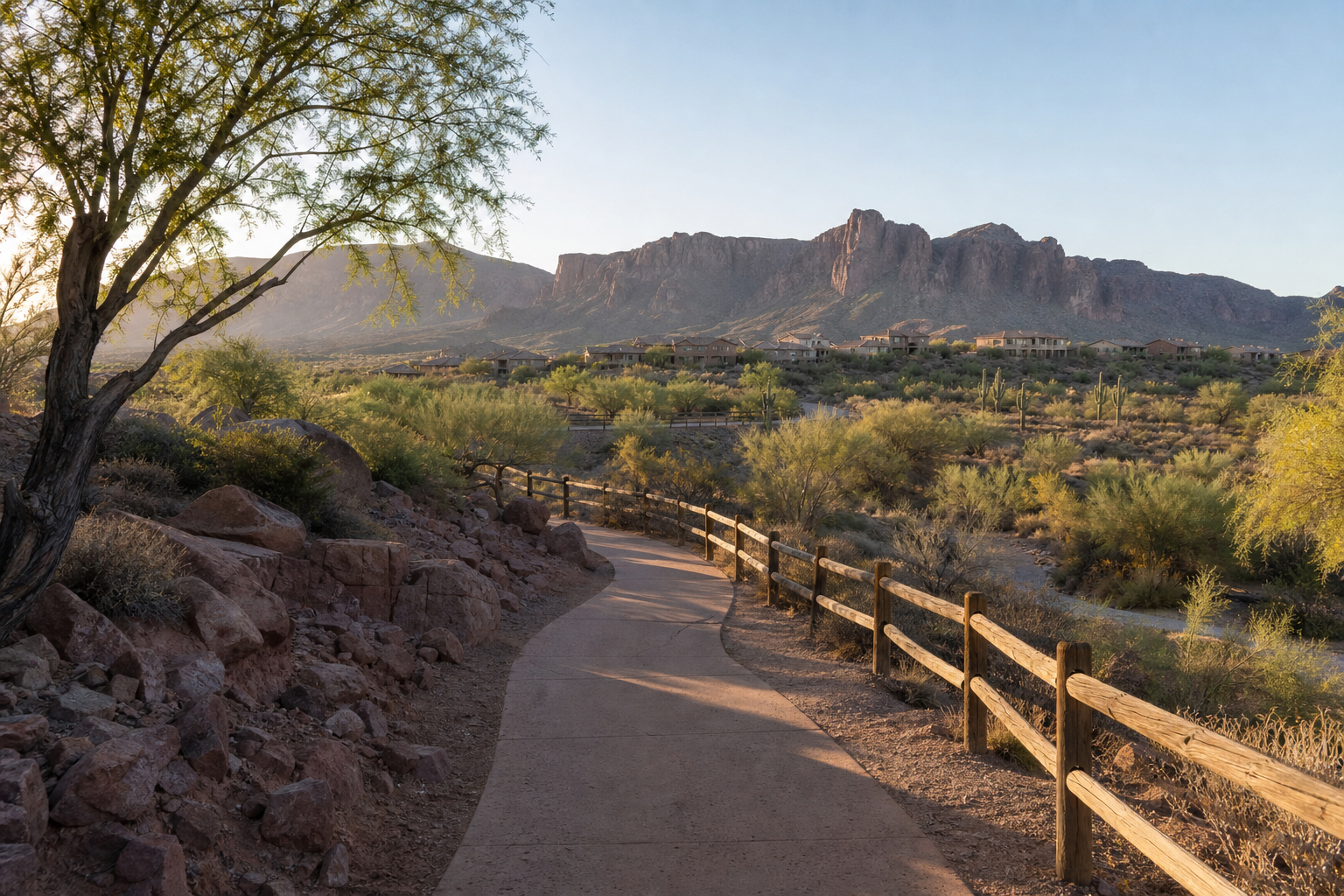
Equal Housing Opportunity. This article is general information only and is not legal, tax, or financial advice. Confirm your specific numbers and property details with your title company, tax advisor, or lender. County jurisdiction, tax rates, utility arrangements, and HOA rules apply to the specific parcel and should be verified directly with the relevant county and providers. Days-on-market and market figures are as of the measurement windows noted and are subject to change. The featured image is an AI generated illustration and does not depict a specific property.
Categories
Recent Posts