Craving a Tree Lined Street? 4 East Valley Neighborhoods That Deliver That Feel
Craving a Tree Lined Street? 4 East Valley Neighborhoods That Deliver That Feel
There is something about turning onto a street with a full canopy of mature trees that just makes a neighborhood feel like home.
It is the kind of detail that does not show up on a spec sheet, but it changes the entire experience of a place. Shade on a summer walk. A softer look to the architecture. Kids on bikes weaving between dappled light on the pavement.
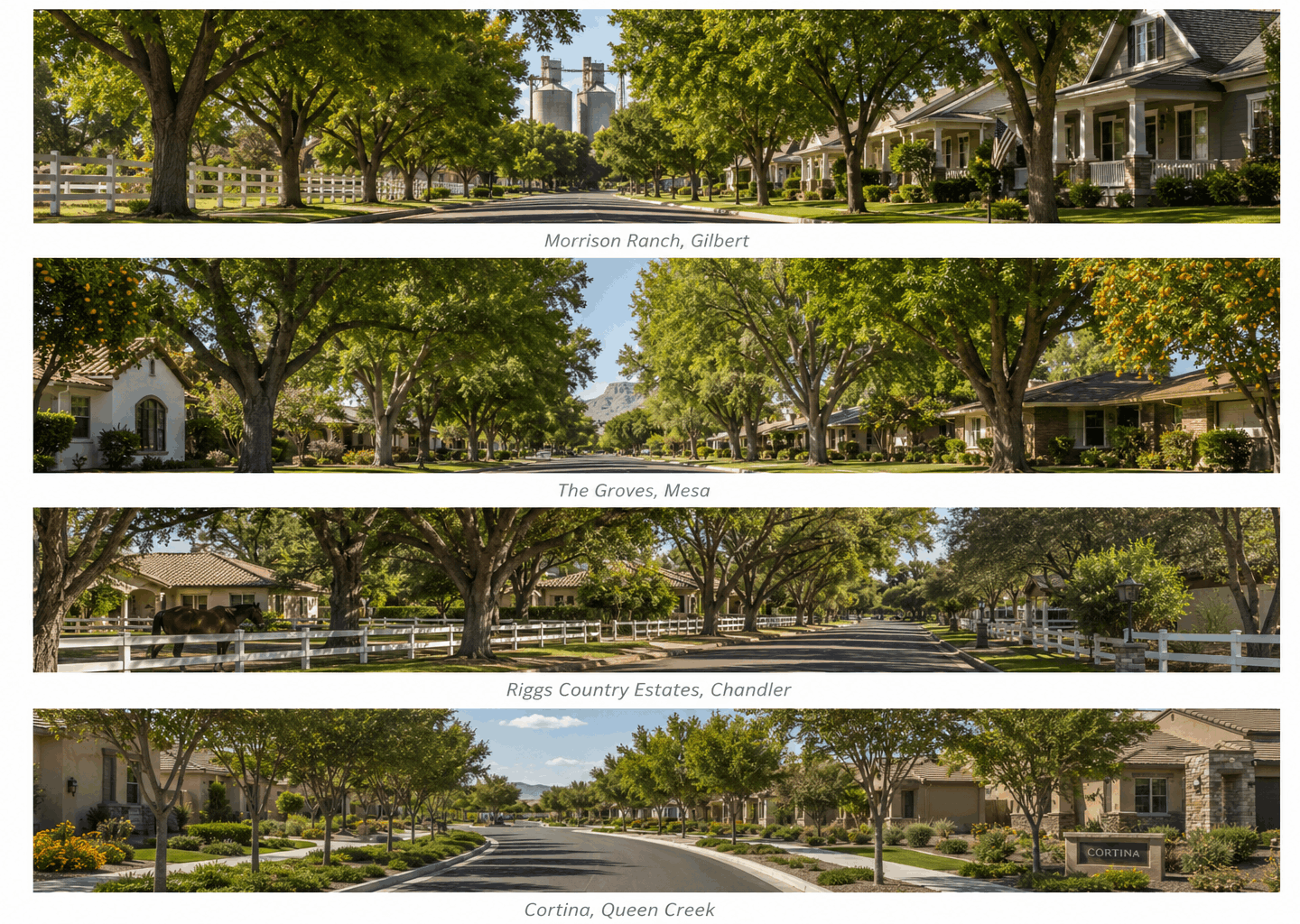
In a desert metro where most neighborhoods are younger than the people living in them, that canopy is genuinely scarce — and it takes decades to grow. If that established feel is what you are picturing, here are four communities that deliver it, one each in Gilbert, Mesa, Chandler, and Queen Creek.
Morrison Ranch
Morrison Ranch is usually the first name that comes up when buyers describe wanting a walkable, tree lined, small town feel without leaving the East Valley. It sits in northeast Gilbert, roughly between Guadalupe and Warner north to south and Sossaman and Greenfield east to west, on land the Morrison family farmed from the 1920s.
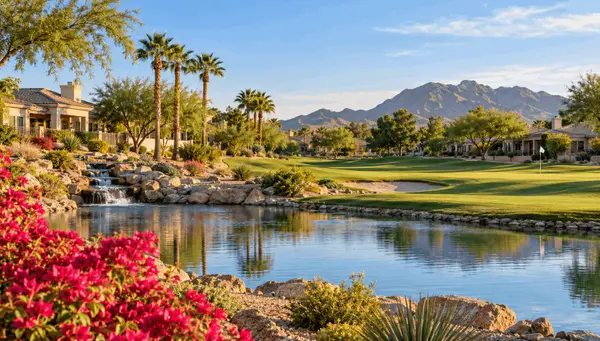
That agricultural history isn’t decoration. Four preserved grain silos still anchor the skyline and have become the community’s unofficial photo backdrop. White rail fencing runs along the streets. There are man made lakes stocked for catch and release fishing, and more than 400 acres of parks and open green space.
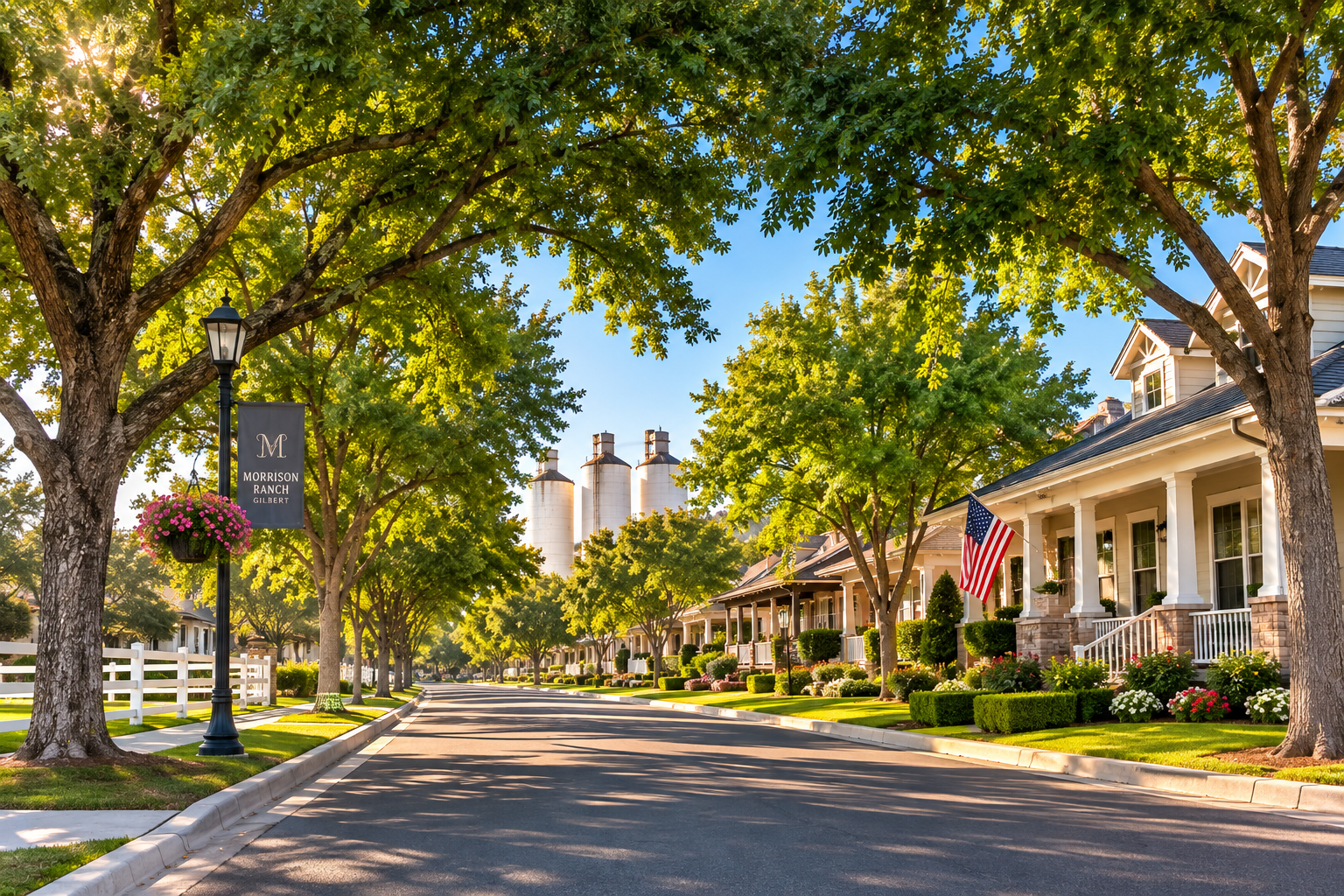
Here’s the part most people don’t know, and it explains everything about how the place looks: the community’s design guidelines actually require it. Front yards must be substantially grass — roughly 50% coverage on narrower lots and 60% on wider ones. Homes need generous front porches. Architectural styles are steered toward Ranch, Prairie, Craftsman, Bungalow, and Rural Contemporary, with Mission, Spanish, Tudor, and Victorian generally considered incompatible.
The tradeoff is real: those green front yards need water, and HOA design review means you don’t get to do whatever you want with your facade. For buyers who want the look, that’s exactly the point. For buyers who bristle at architectural committees, it’s worth knowing before you fall in love.
There’s enough variety here — from cottage style homes to larger executive properties across seven distinct sub-neighborhoods — that the price range is wide. Served by Gilbert Unified School District.
One clarification worth making: people often ask about “the Mesa side” of Morrison Ranch. Only one neighborhood, Desert Place, actually falls within Mesa city limits. If a Mesa address is the priority, that’s your single option here — which is part of why the next entry matters.
The Groves
If Morrison Ranch is a tree lined street by design, The Groves is a tree lined street by inheritance.
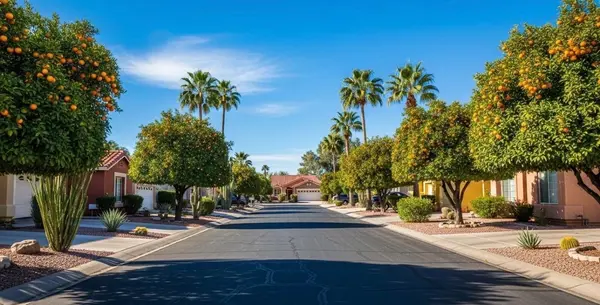
This northeast Mesa neighborhood — bounded roughly by McKellips, Brown, Greenfield, and Val Vista — takes its name from the citrus groves that covered the land before homes went in during the 1940s. Many of those citrus trees are still standing, lining the streets and filling the air with blossom every spring. The canopy here is eighty years old, and it shows.
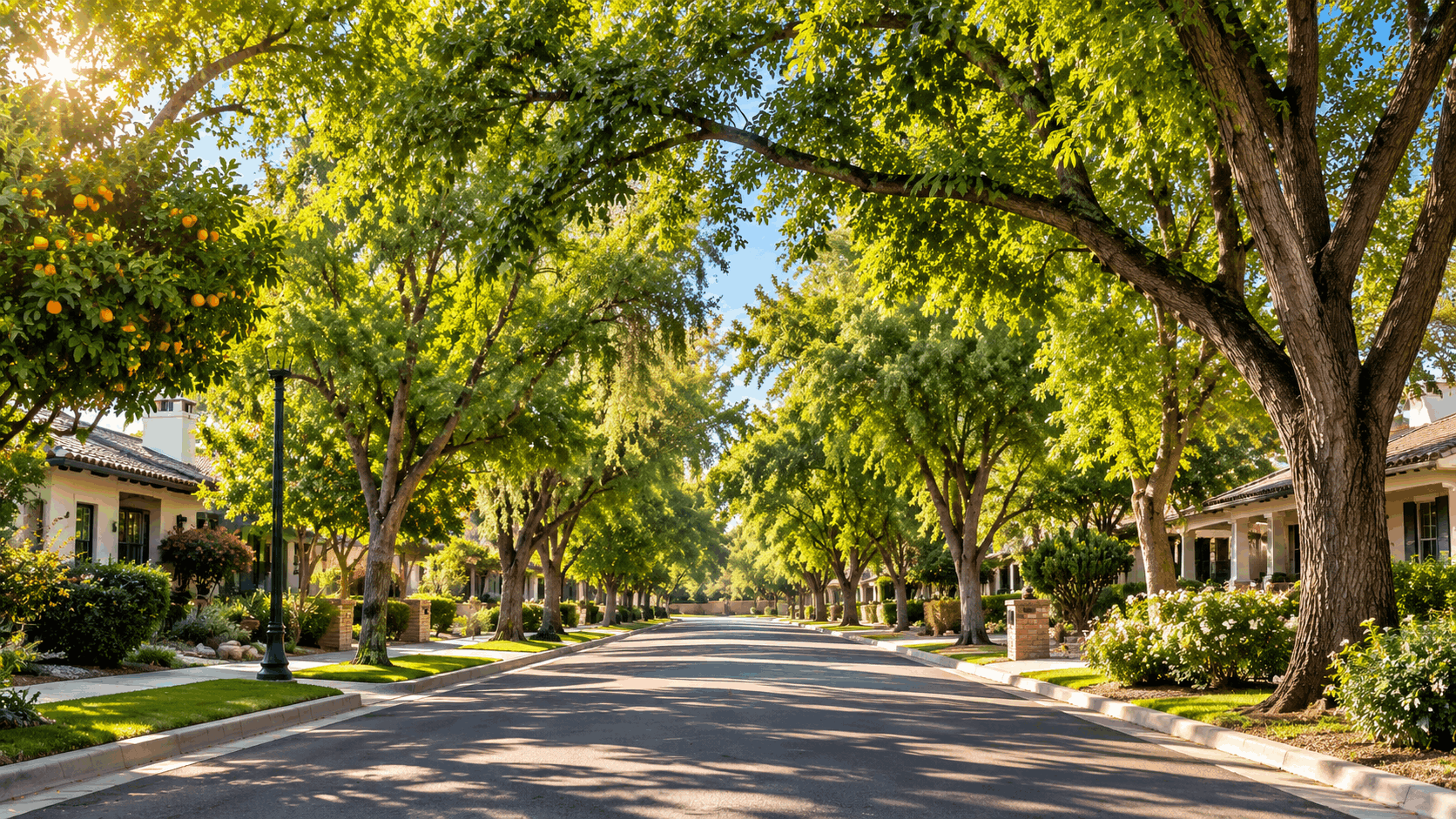
What you get alongside the shade: larger lots than newer Mesa subdivisions offer, genuine architectural variety — ranch, two story Spanish, American Colonial, sometimes on the same block — and, for much of the neighborhood, no HOA. That’s the mirror image of Morrison Ranch. Nobody planned the variety here; it accumulated from eighty years of individual owners making their own choices.
The Eastern Canal Trail runs alongside for everyday walking, and parts of the neighborhood have Superstition Mountain views. Worth knowing that the southern portion includes RV resorts and mobile home communities, so the specific street matters a great deal. I’ve written about The Groves in more detail here.
Riggs Country Estates
Chandler’s version of this feel leans a different direction entirely: bigger lots, a more rural and equestrian friendly layout, and mature trees that have had decades to fill in.
Lots here run large by East Valley standards — roughly four tenths of an acre up past an acre in places — in south Chandler’s 85249. This is a neighborhood for buyers who want space along with their shade: room for horses, room for a workshop, room for an RV, or simply room to breathe between houses.
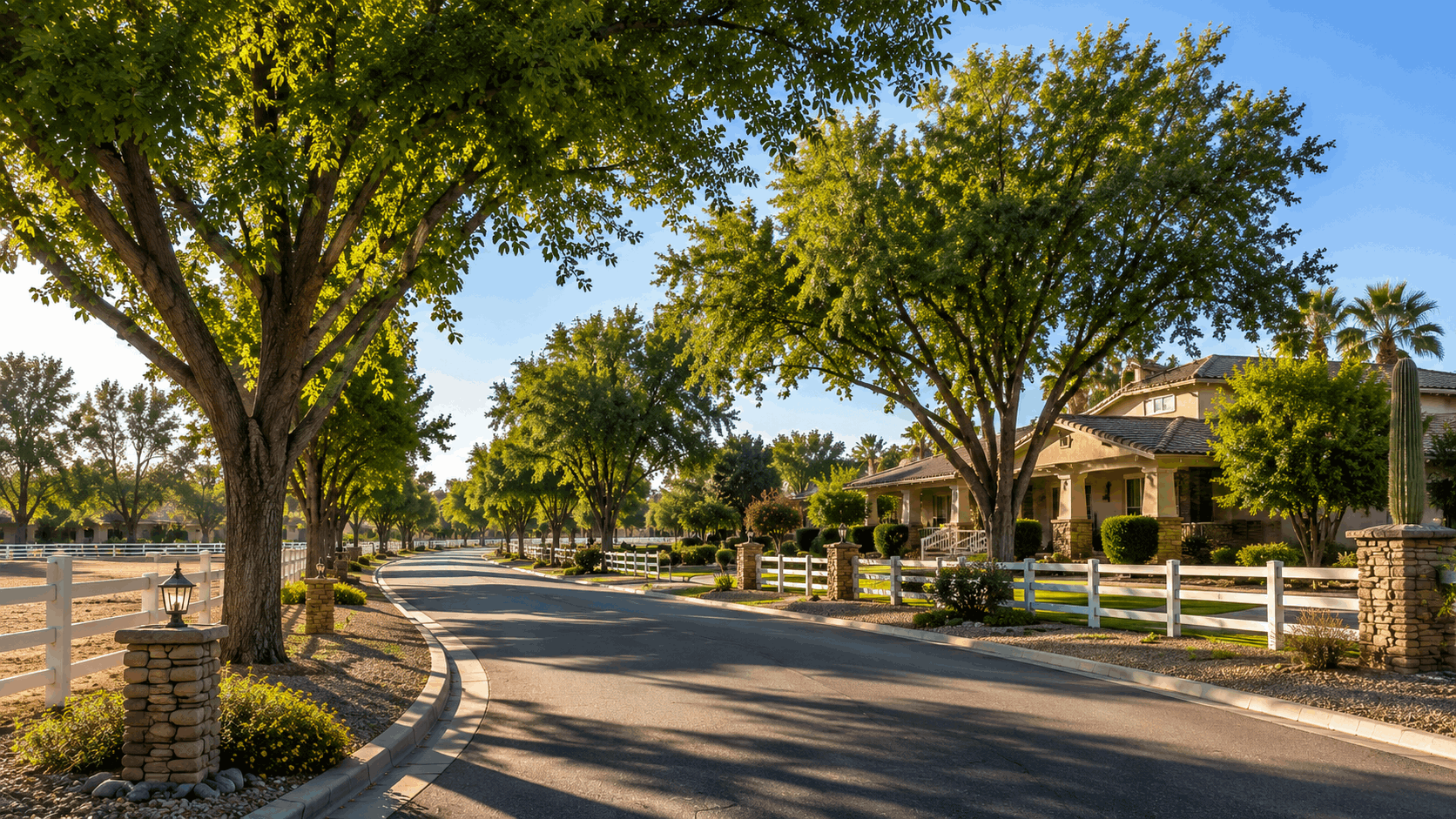
The combination of acreage style living with a genuinely green street presence is hard to find inside Chandler city limits, and it prices accordingly — this is the most expensive entry on the list. Residents tend to stay a long time.
Worth noting that Chandler has more than one community with “Country Estates” in the name, including Anatolian Country Estates with its own large homesites and HOA approved horse, casita, and RV allowances. If the acreage-plus-trees combination is what you’re after, it’s worth touring both.
Cortina
Cortina is the newest community on this list, and it makes a different argument: that thoughtful landscaping can deliver an established feel faster than you’d expect.
Sitting east of Power Road and south of Pecos Road, Cortina was planted with lush greenbelts running behind and between the homes rather than the minimal desert landscaping that defines a lot of 2000s-era subdivisions. Listings here routinely mention backyards bordered by green space, and the community includes pools and playgrounds.
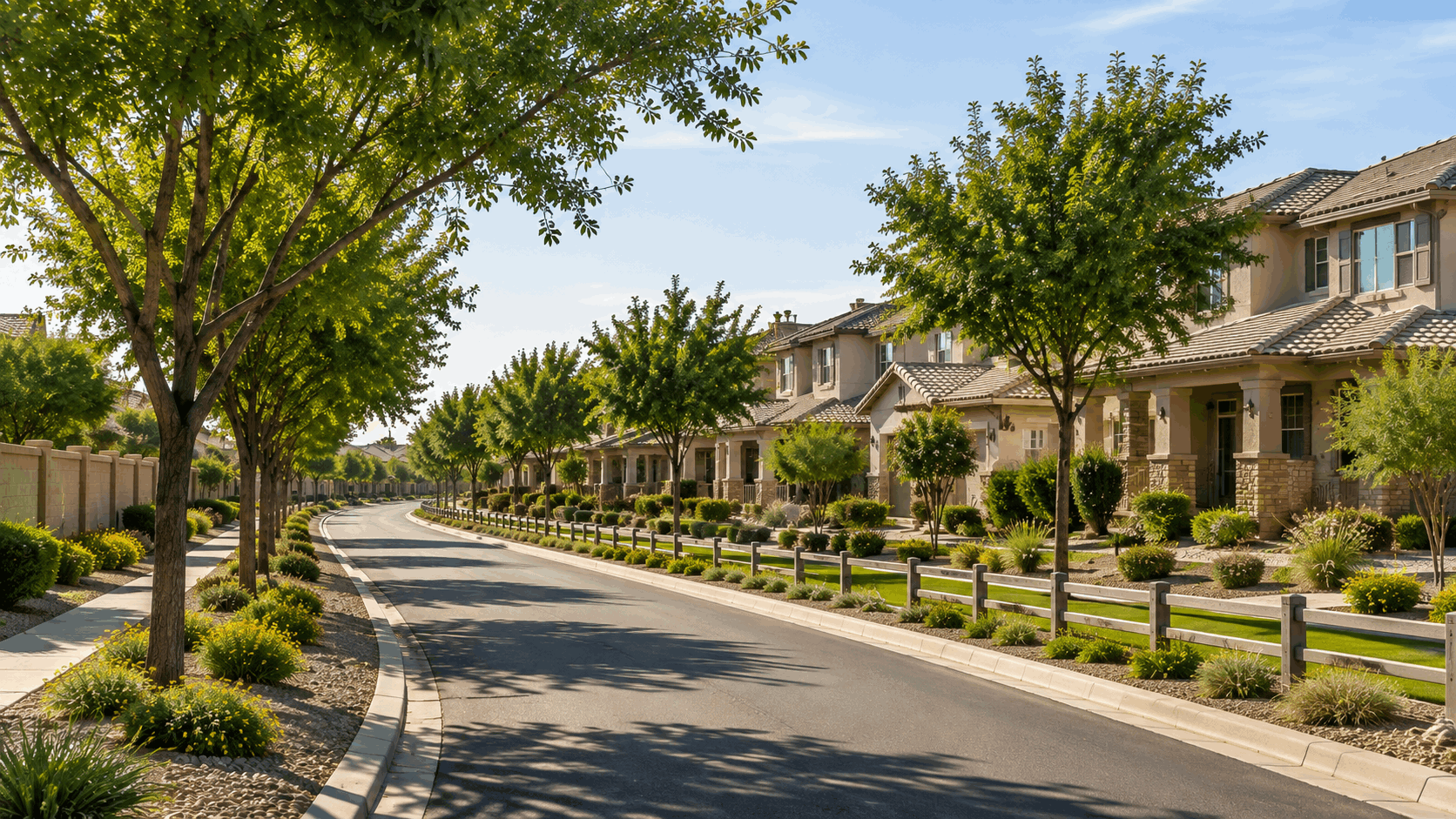
I’ll be straight about the tradeoff: Cortina is a car dependent suburban community, not a walkable one. The greenery is real and the streetscape is pleasant, but you are not strolling to a coffee shop from here. What you get instead is more house and more yard for the money than the other three, in a Queen Creek that still has small town energy.
For buyers who want green surroundings and newer construction — modern floor plans, current systems, nothing to renovate — Cortina is the entry on this list that delivers both.
Which One Fits You Best
All four deliver the canopy. The lifestyle underneath it is genuinely different.
- Morrison Ranch — walkable and community centered, with design rules that guarantee the look and an HOA that enforces them.
- The Groves — the oldest canopy, the biggest architectural variety, and no HOA for much of it. Older homes and older systems.
- Riggs Country Estates — spacious and semi-rural. Horses, workshops, acreage. The highest price point here.
- Cortina — newest construction, greenbelts rather than old growth, most house for the money, least walkable.
One thing I’d tell anyone shopping for this specific feeling: go walk the street at 4pm in July. A canopy that looks lovely in a February listing photo either delivers real shade in an Arizona summer or it doesn’t, and there is only one way to find out.
The right fit depends on your budget, your must haves, and the kind of everyday life you are picturing. If you would like to tour any of these, or want a more personalized list based on what you’re actually looking for, reach out any time. I would love to help you find the tree lined street that feels like yours.
Melissa Bailey
Equal Housing Opportunity. All images in this article are AI generated illustrations intended to convey general character and are not photographs of the communities named. Neighborhood boundaries, HOA rules, design guidelines, and school assignments are approximate, vary by source, and are subject to change — verify for any specific address before making a decision. This article is general information only and does not constitute legal, tax, or financial advice.
Categories
Recent Posts